

Long-Term Investment · Phased Development · Modular Planning
DONGSHENG COLUMBARIUM | INSIGHTS
A columbarium is not a short-term installation. It is a long-term memorial development that may serve families and communities for decades. Once a facility begins operating, the project continues to evolve: occupancy increases, new memorial areas may be introduced, and additional capacity may be required.
For developers and operators, this changes the planning question. The objective is not simply to determine how many niches are needed on opening day. It is to understand how the project may grow over its full operating life—and to make sure Phase 1 does not restrict that future.
As cremation becomes increasingly common in many markets, long-term demand for organized, accessible and well-planned memorial space deserves consideration from the earliest stage of development. Future expansion should therefore be treated as part of the original investment strategy, not as a problem to solve later.
1. Think Beyond Opening-Day Capacity
A project may need only 1,000 or 2,000 niches when it first opens, while the building or site may ultimately support several times that capacity.
In this situation, the project should not be designed simply as a 2,000-niche facility. It should be planned as a larger long-term development in which Phase 1 happens to contain 2,000 niches.
This distinction affects the master layout, circulation, infrastructure, module dimensions and future construction strategy. The long-term capacity should be understood first; the opening capacity can then be selected as the first step toward that larger plan.
2. Expansion Is Part of the Investment Strategy
Installing the entire long-term capacity at the beginning is not always necessary. A phased approach can allow investment to follow actual demand rather than committing all capital before the space is required.
A typical development may progress from an initial operational phase, to additional capacity as occupancy increases, and later to new memorial zones or buildings. The exact timing does not need to be known on Day One.
What matters is that the possible future scale is understood before Phase 1 is finalized. In this way, expansion becomes a planned investment decision rather than an emergency response to insufficient capacity.
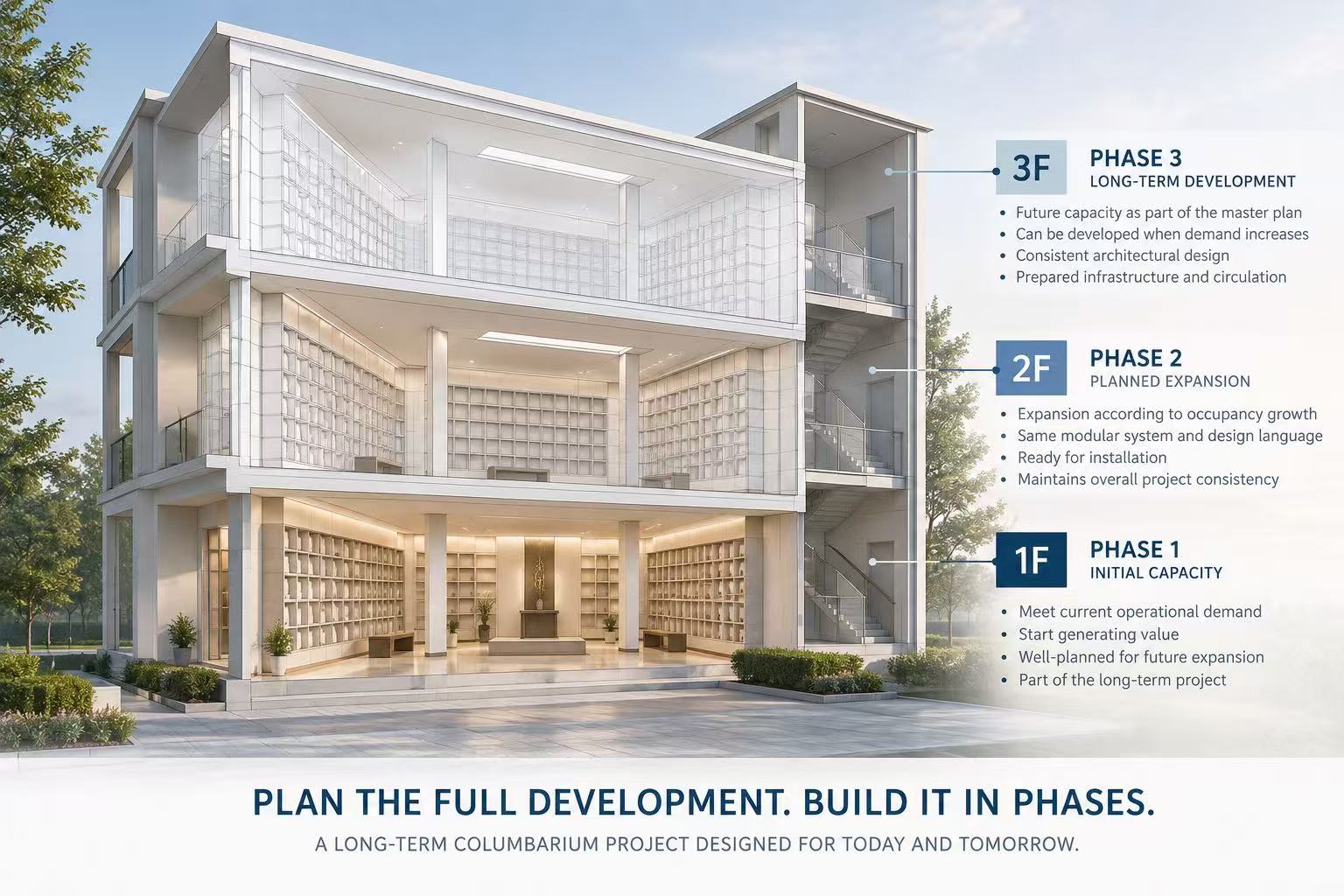
3. Reserve Expansion Zones—Not Just Empty Space
Leaving an empty wall or unused room does not automatically create a future expansion area. Expansion zones should be intentionally identified in the floor plan.
The project team can distinguish between immediate installation areas, reserved expansion areas and long-term development zones. These may be located within the same hall, on another floor, in a future building or in a separate outdoor memorial area.
This prevents future niches from gradually occupying space that was actually needed for visitor circulation, ceremonial use, maintenance access or building services.
4. Protect the Future Layout and Infrastructure
Every new niche wall changes the way people move through a facility. If capacity is added without a long-term plan, corridors can become narrower, visitor routes can become complicated and future construction can interfere with completed memorial areas.
The same principle applies to infrastructure. Lighting, electrical routes, ventilation, fire-safety systems, security, access control and digital management infrastructure may all need to support later phases.
Not every future component must be installed immediately. But the building should be prepared so that future systems can be added without unnecessary demolition or major reconstruction.
5. Use a Modular Standard That Can Continue
Phased development works best when Phase 1 is designed as the first part of a repeatable system. Niche dimensions, module widths, structural interfaces and key installation details should be coordinated from the beginning.
Future phases do not need to look completely identical. Materials, colors, memorial products and premium areas may evolve over time. However, the underlying system should remain compatible enough for new work to feel like a continuation of the original project.
This is where modular planning becomes more than a manufacturing method. It becomes a tool for protecting long-term flexibility.
6. Plan Future Work Around an Operating Memorial
Expansion in a columbarium is different from expansion in an empty commercial building. Once niches are occupied, families may be visiting the facility while later phases are being installed.
Future construction should therefore consider installation access, separation of work zones, visitor routes, dust and noise control, protection of completed niche systems and the movement of materials through the building.
Planning these conditions during Phase 1 can significantly reduce disruption when Phase 2 or Phase 3 begins.
7. Keep the Project Record for the Next Phase
A future phase may begin several years after the original installation. By then, the architect, project manager or project team may have changed.
Approved drawings, niche and module dimensions, material and finish references, installation details, phase boundaries and future expansion drawings should therefore form part of the project record.
Good documentation allows the next phase to continue the original design logic instead of trying to reconstruct it from the completed building.
Design the Final Vision—Then Decide What to Build First
The strongest long-term projects do not begin by asking, “Where can we add more niches later?” They begin by asking, “What could this development ultimately become?”
Once that long-term vision is understood, the project team can decide what belongs in Phase 1, what should be reserved for Phase 2 and what may remain part of the longer-term master plan.
LONG-TERM VISION → MASTER LAYOUT → PHASE PLAN → PHASE 1 → FUTURE EXPANSION
Dongsheng's Approach to Long-Term Project Planning
At Dongsheng Columbarium, we view Phase 1 as part of the future project—not as an isolated installation.
When reviewing a project, we can consider the initial capacity target together with the potential long-term capacity, modular layout, expansion zones, dimensional coordination and future installation access.
The objective is not simply to add more niches later. It is to ensure that what is installed today does not limit what the project may need tomorrow.
Plan Today. Expand Tomorrow.
A developer does not need to predict the exact date of every future phase. But before Phase 1 is finalized, it is valuable to understand where future growth may occur and how the original project can support it.
For a new columbarium development, share your floor plan, initial capacity target, long-term capacity target and proposed development concept with Dongsheng. We can discuss a modular strategy that supports both the immediate project and its future expansion.
DONGSHENG COLUMBARIUM
Columbarium Systems & Project Solutions